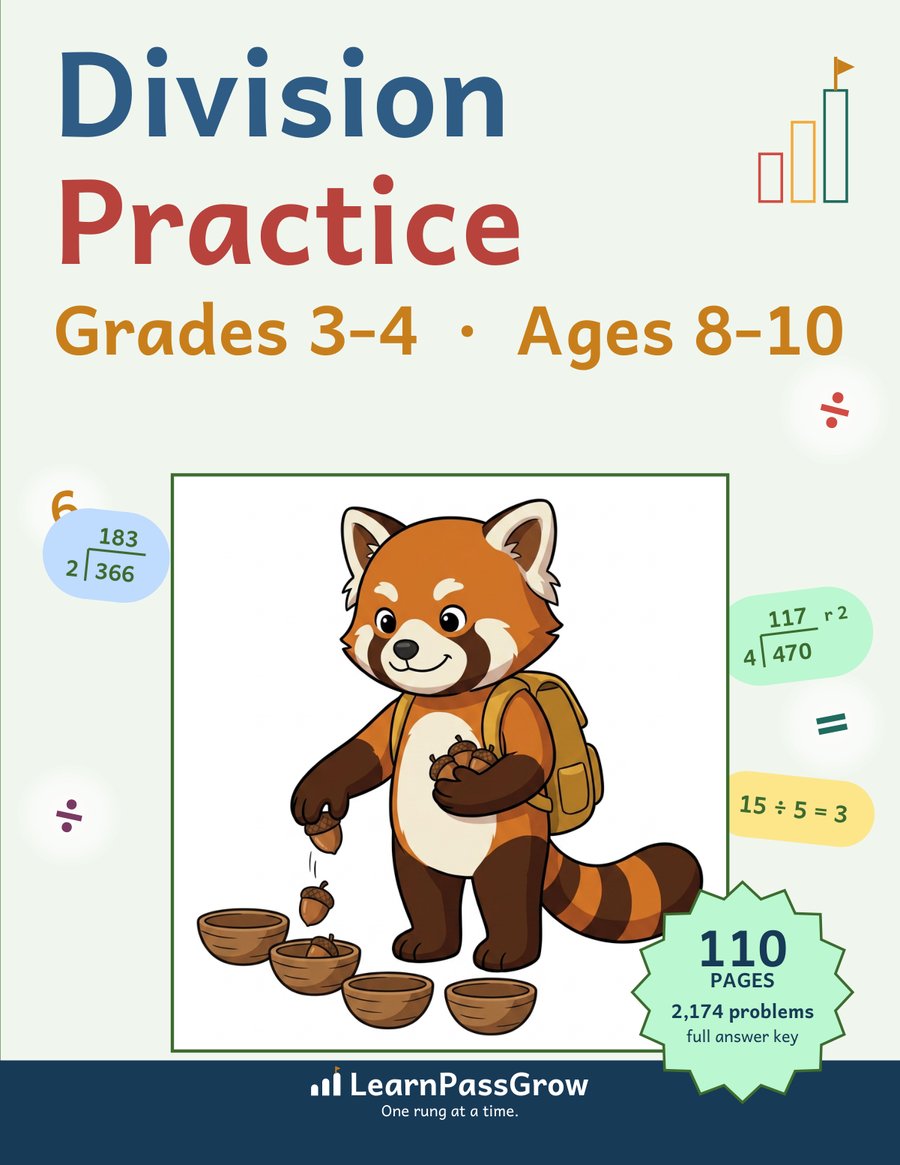
Division Practice
Grades 3–4, Ages 8–10 — 2,174 Problems in 76 Practice Sets: Fact Families, Missing Numbers, Remainders, Division Stories, Estimates, Partial Quotients, Worked Divisions to Judge and 4-Digit Long Division, Full Answer Key
No room to work the division? Here there is.
Buy the paperback
Listings open in a new tab. Prices and delivery are shown on the store; the same book is on every marketplace, so pick the one that ships to you.
Inside this book
- 2,174 problems in 76 one-page practice sets
- A placement check routes your child to the right starting set
- Full answer key, independently re-checked before printing
- Personal-best and finished-sets pages make progress visible
- 8.5 × 11 inches · 110 pages · grades 3–4 (8–10)
Look inside
Real pages from the printed book, not mock-ups.
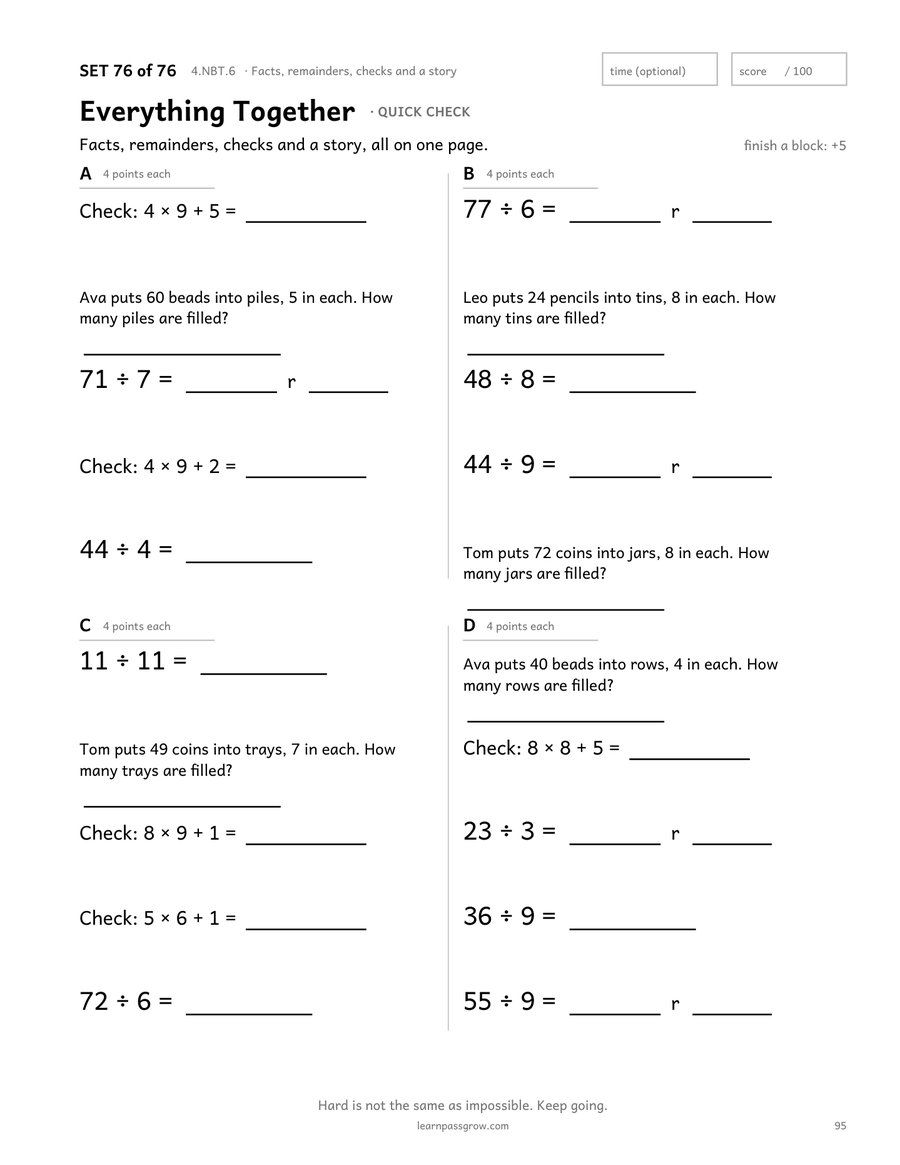
About this book
Multiplication, run backwards — and asked twenty-six ways.
110 pages · 76 practice sets · 2,174 problems - every one with its answer in the full printed key, the four Check Yourself pages worked through at the back, and Division Words last: every term with the page that practices it.
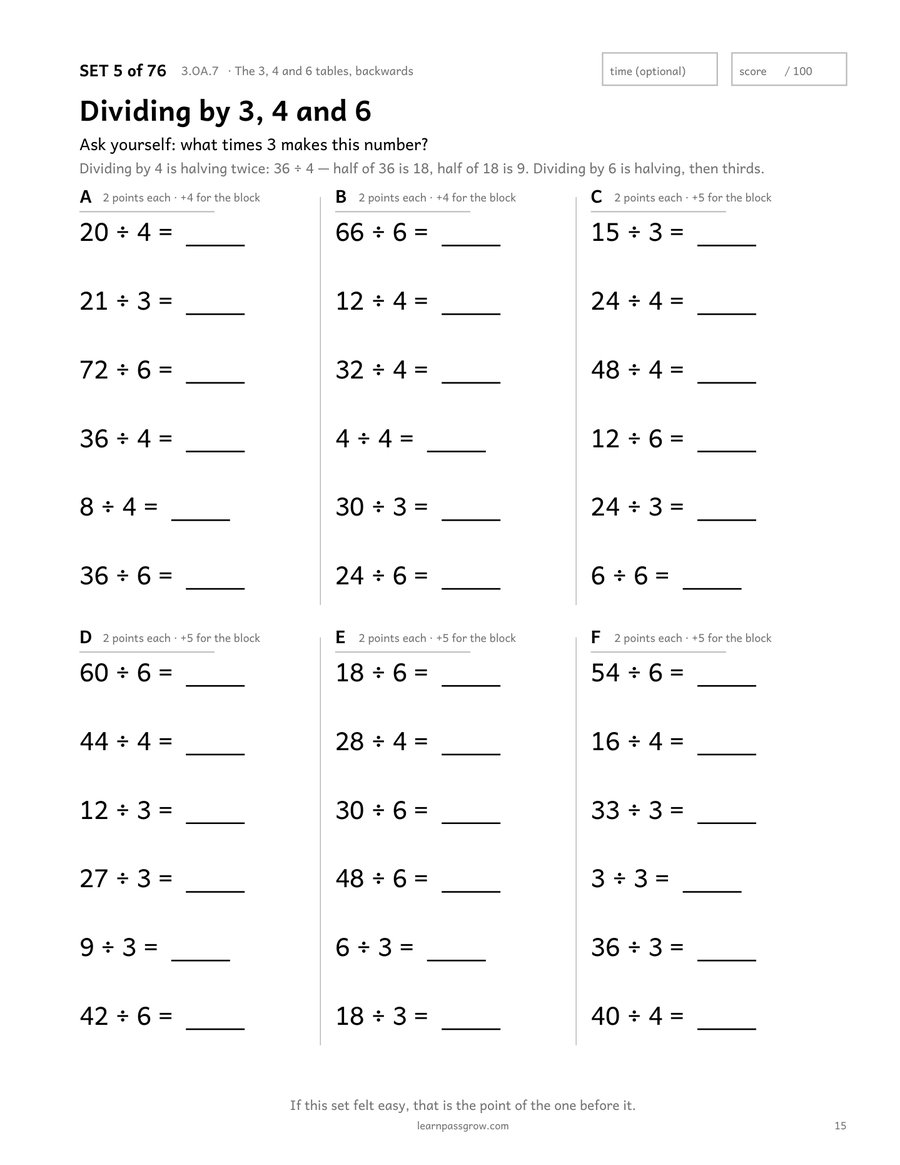
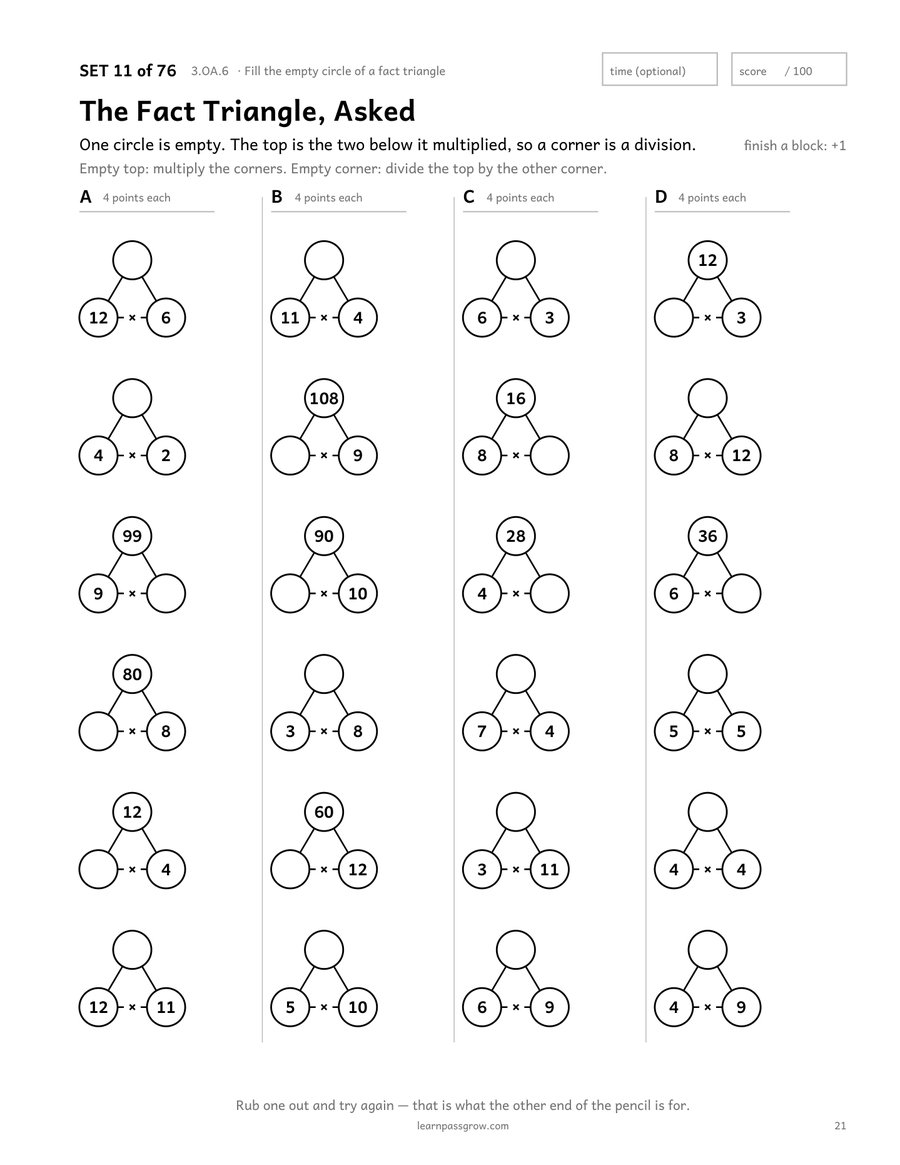
Division is where the times tables pay off, and this book makes the connection explicit: the first pages draw the rows and groups the ÷ sign is talking about, then every fact in Stage 1 is a multiplication fact read backwards, so a child who knows 6 x 7 already knows 42 ÷ 7. From there a ladder of 74 short sets climbs through the fact family, the missing number, the sign and the undo, patterns, dividing by 10, 100 and 1,000, factors and multiples, money and two-step stories, remainders as real leftovers - and what a story does with them - to long division in the classic bus-stop frame, taught as the five-move loop it actually is: divide, multiply, subtract, compare, bring down.
Is it right? Two pages print a worked division in full, carrying one slip or none, and the child names the step that went wrong or writes correct - the error-analysis page the tests use.
The steps fade. The first long-division frames print the five moves beside them, the next set prints faint guides where the working goes, then the frame is bare. A worked example shows the whole loop inside the frame, and a page names the zero in the quotient: 416 ÷ 4 is 104, not 14.
The strategies the standard names and most books skip. Estimate first with compatible numbers. Check it by multiplying. Break the number apart and divide the pieces - the partial quotient. Two-digit dividends before three-digit ones; two-digit divisors and four-digit dividends at the top.
A page for the grown-up before each stage. What the stage teaches, the words it uses, a checklist to color as the skills are done, and what to say when a child is stuck. Beside every set number is the skill in plain words, the last page of every skill is marked QUICK CHECK, and on the review pages the key names the page that teaches each item.
Not the same page over and over. Twenty-six kinds of question, the rule on every page, three reference pages, three Looking Back pages, four Puzzle Breaks - follow the path, division chains, remainder riddles with a bingo card, who am I? - and a Ready for Grade 5? page.
No wall of problems. Every page is a handful of small lettered blocks worth 100 points together; every frame has real room to work, and the Check Yourself pages carry a Y/N column to mark against the key.
An answer key you can trust, by construction. Every answer was generated together with its problem and independently re-checked by a separate program before printing - every worked division replayed line by line, the riddles re-solved by search, the path maze walked again from its own labels. The key and the pages agree by construction, not by proofreading.
Inside:
- 76 practice sets and 2,174 problems across four stages: the facts; missing numbers and the rules; remainders; long division
- Rows and groups, fact families, the missing number, the sign and the undo, patterns, true or false, seven kinds of division story, the remainder interpreted, divisibility, factors and multiples, the estimate, the check, the partial quotient, the frame, a zero in the quotient, worked divisions to judge
- The rule on every page, three reference pages, a parent page before each stage, Division Words at the back
- Three Looking Back pages, four Puzzle Breaks and a Ready for Grade 5? page
- Full printed answer key, machine-checked at build time, with the working for every Check Yourself answer
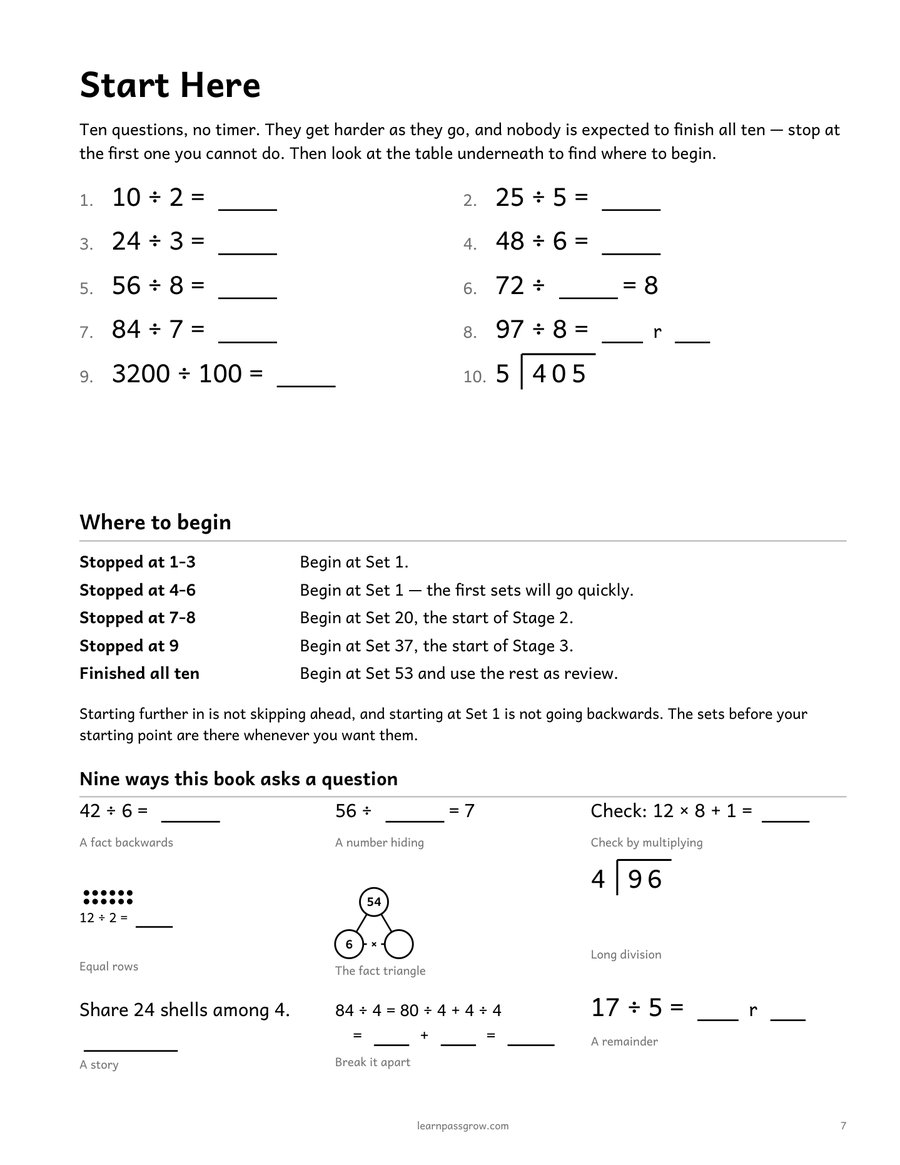
- Start Here placement check with a gallery of the question shapes, badge tracker, personal-best log and a certificate - copy-friendly for one family or one classroom
Questions parents ask
- What age is Division Practice for?
- Division Practice is written for grades 3–4, as the listing states. The reader band is on the cover and the title page.
- How many pages does it have?
- The paperback is 110 pages, 8.5 × 11 in, black-and-white interior on white paper.
- Is it a paperback or an ebook?
- A printed paperback, sold on Amazon in the United States, Canada, the United Kingdom and Australia. The buttons on this page open the listing for each marketplace.
- Does it include an answer key?
- Yes. Every answer is printed in the back, and every problem and its answer were generated together and re-checked by a separate program before printing.
- Who makes LearnPassGrow books?
- LearnPassGrow is the imprint behind every book on this page, and the same team runs learnpassgrow.com, where the free printables and extras live.
One of 18 LearnPassGrow books
Practice workbooks for the school years, every answer checked by construction. Browse the whole shelf, or start with four that go well with this one.
Learn Pass Grow is the publisher of this book. Purchases happen on the store you choose; we show no prices here because the store's price is the one that counts.